Sections
Overview
Sections are the module of document. Use section to insert different type of unstructured data. When you define sections at the table level, you force all future created records to include these sections.
Changes to the section will NOT affect any of the existing records. Unsigned records can be reformatted to match the default sections. A record can be altered by adding new sections and archiving existing sections after it is created.
If you're just getting started with Labii, you don't need to configure all default sections at once. Add the first set of sections, and you can always update them as you test and use it.
In the case of a need for different default sections, users can create a template with all the necessary sections and use it to create new records.
List of sections
Each table has its own default sections. Open a table and click the Sections tab to view the list of sections.
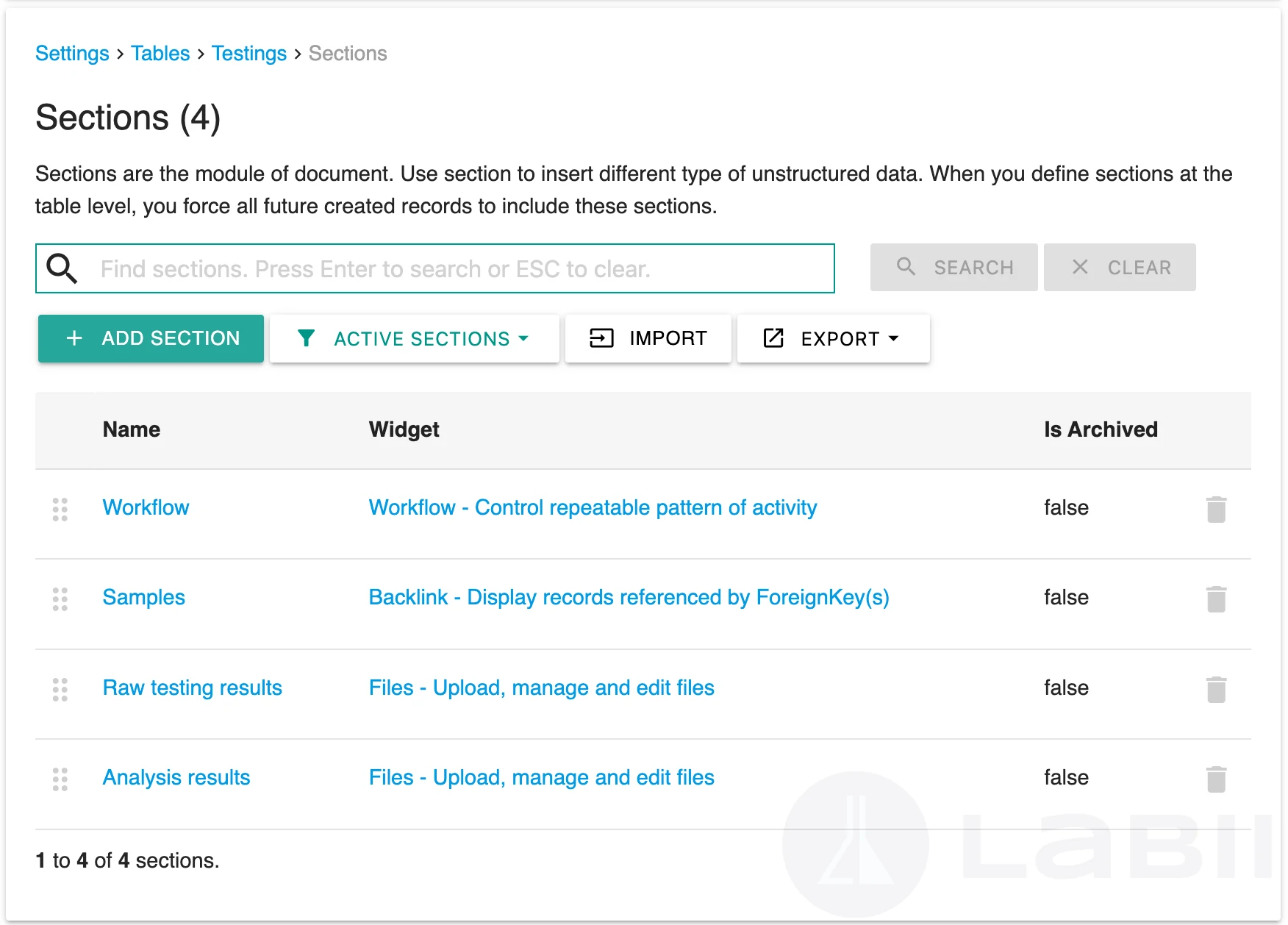
Search sections
You can search sections by typing a keyword into the search bar in the sections list view, and then clicking Search. The search results can always be cleared by clicking the Clear button.
Filter sections
With the Filter function, you can limit the number of sections displayed. You can do that by clicking Active sections and then selecting a filter from the dropdown. Here are a list of filters:
- All sections. Filter to display all sections of the table.
- Active sections. Filter to display the active sections.
- Archived sections. Filter to display the archived sections.
Section detail
Click a section name to see full detail of a section.
Section fields
- Sid - The unique identifier of the section
- Table - The table this section belongs to
- Name - Name of the section that will be displayed to users
- Description - Description or help text of the section
- Widget - The widget to use. Learn more about available widgets here. If a widget is not available, you can enable it here
- Order - Display order of the current section
- Data - Default data to be loaded. The default data should be updated as follows:
- Use an existing record or create a new one.
- Find the section with the current name and widget under the Sections tab.
- Load the Edit model to configure the section.
- Click the Actions button and then choose Save as table default from the drop-down menu that appears.
- Ref - Reference text to matching current section in the json template
- Is Required - Automatically add this section to new records. Uncheck for optional sections that users can add manually
- Is Archived - If checked, data is not available for use. Check this to hide/delete this section
Add a section
Click the "+" at Settings -> Tables -> Sections to add a section.
- Widget - The widget to use. Check out Settings -> Widgets for more details of each widget. Please try not to change the widget, data from one widget does not compatible with the other.
- Name - Name of the section
- Description - Description or help text of the section
- Order - Display order of the current section
- Data - Default data to display
How does the data of a table section different from organization default section data?
Both can create default data for a section. The major difference is: organization default data can be created for any sections, while the section data can only be applied to the default sections.
Add section from template
Labii consistently updates the templates of table sections. You can use the Add section from template function to add a missing section from a template.
Click the Add Section dropdown button
Select Add from a template from the dropdown menu
Choose a section from the modal that appears
Add section via JSON
This feature is designed for advanced users who need to create sections programmatically or in bulk using JSON code.
Adding sections via JSON is useful when you need to:
- Create multiple sections with complex configurations
- Replicate section structures across tables
- Automate section creation through scripts
- Migrate section definitions from another system
JSON structure
A section definition can include the following properties:
{
  "name": "Section Name",
  "description": "Description of the section",
  "widget": "widget_name",
  "order": 100,
  "data": {},
  "ref": "section_reference",
  "is_required": true
}
Add the section
Navigate to the Sections tab of your table.
Click the Add Section dropdown menu.
Select Add via JSON.
Paste the section JSON into the editor.
Click Submit to create the section.
Make sure the JSON is valid and includes the required fields. Invalid JSON prevents Labii from creating the section.
Import sections
Multiple sections can be created simultaneously using Import. You can do this by clicking Import in the section list view.
Export sections
You can export a list of sections by clicking Export button and select one option from the dropdown.
Change the order of sections
The order of columns can be changed via dragging a column to a different position. You can also update the value of the section order.