> For the complete documentation index, see [llms.txt](https://docs.labii.com/llms.txt). Markdown versions of documentation pages are available by appending `.md` to page URLs; this page is available as [Markdown](https://docs.labii.com/applications/electronic-lab-notebook/eln-for-research-and-development.md).
# ELN for Research and Development
Designed to assist researchers and developers in quickly documenting their daily work and meeting regulatory requirements.
## Overview
Research and development work focuses on innovations and proof of concepts, often using a small set of samples. Scientists prefer to capture results quickly and with minimal effort, documenting their daily work in a way that remains scientifically replicable and meets regulatory requirements. The [ELN for Research and Development](https://www.labii.com/products/electronic-lab-notebook-eln-for-research-and-development) application provides a streamlined electronic lab notebook designed specifically for R\&D workflows, allowing researchers to focus on innovation rather than documentation overhead.
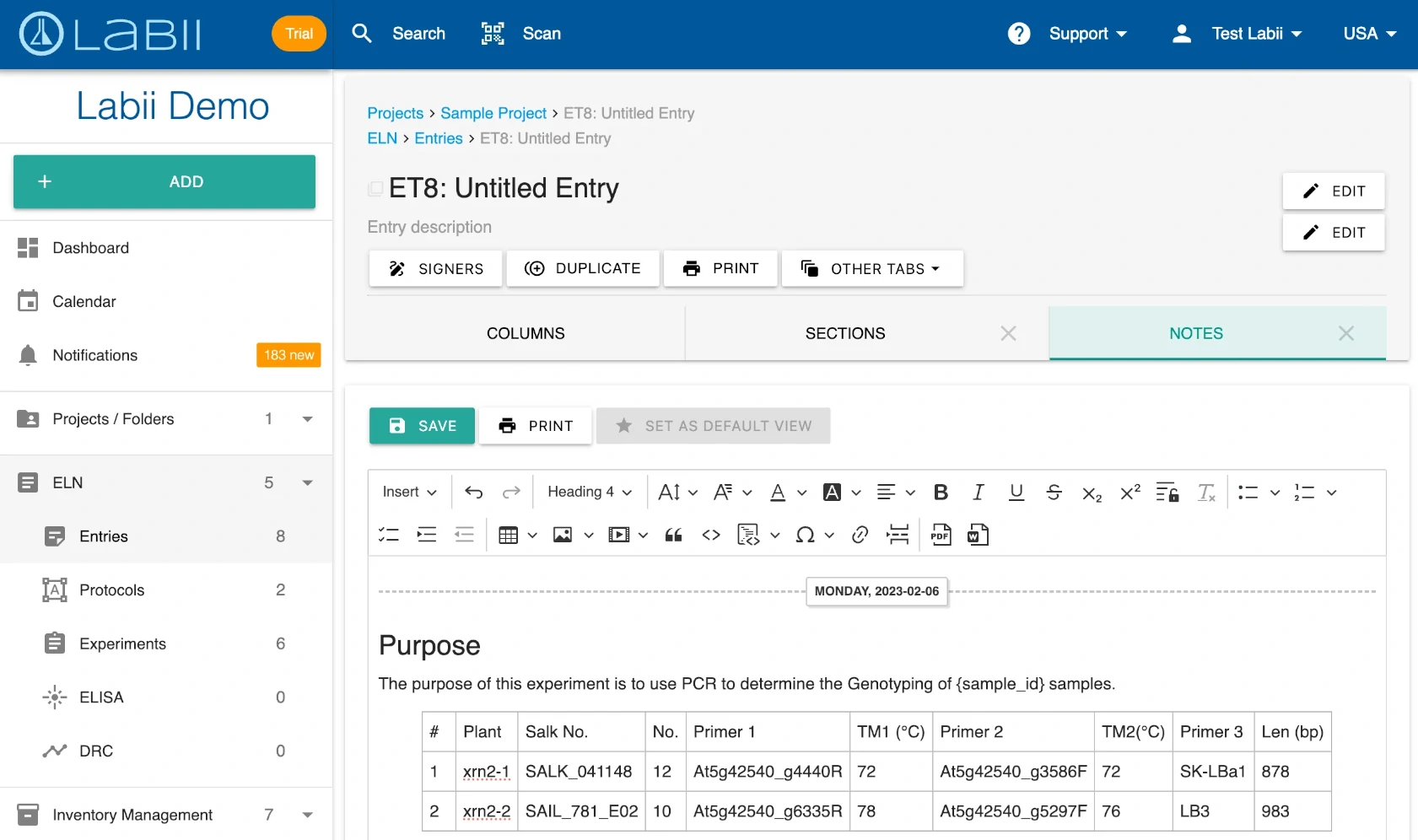
At Labii, we developed the [Notes](/user-guide/detail-view/notes.md) function to make it easy for researchers and developers to quickly document what they worked on each day, while meeting all requirements of an electronic lab notebook. The application combines rich text editing capabilities with structured data management, enabling scientists to create quick notes, detailed protocols, and maintain comprehensive experimental records—all while ensuring data integrity, regulatory compliance, and reproducibility.
ELN for Research and Development provides a flexible interface for documenting daily research activities
{% embed url="" %}
{% hint style="info" %}
This application is ideal for research environments where flexibility and speed are prioritized while maintaining compliance with regulatory standards such as FDA 21 CFR Part 11.
{% endhint %}
## Use Cases
### Academic Research
* Document exploratory experiments and pilot studies
* Track proof-of-concept investigations
* Maintain research notebooks for graduate students and postdocs
* Create reproducible records for publications and dissertations
* Share research progress with advisors and collaborators
### Pharmaceutical R\&D
* Record early-stage drug discovery experiments
* Document compound synthesis and characterization
* Track assay development and optimization
* Maintain GLP-compliant research records
* Support patent applications with legally defensible documentation
### Biotechnology Research
* Document protein expression and purification experiments
* Track cell culture experiments and observations
* Record molecular biology procedures
* Maintain records of genetic engineering workflows
* Support regulatory submissions with compliant documentation
### Chemical Research
* Document synthetic chemistry experiments
* Track reaction optimization and scale-up studies
* Record analytical method development
* Maintain safety-compliant experimental records
* Create reproducible protocols for laboratory procedures
### Quality Control Development
* Document method development experiments
* Track validation study results
* Record troubleshooting activities
* Maintain audit trails for regulatory inspections
* Create standardized testing protocols
## Getting Started
{% stepper %}
{% step %}
Navigate to **Settings → Applications** from the main menu
{% endstep %}
{% step %}
Click **Add application** and select **Add from a template**
{% endstep %}
{% step %}
Choose **Electronic Lab Notebook** from the template list
{% hint style="warning" %}
If the Electronic Lab Notebook option is not available, it means the application is already installed in your account.
{% endhint %}
{% endstep %}
{% step %}
Wait for the installation to complete. The system will automatically create:
* **entry** table for daily experiment documentation
* **protocol** table for standardized procedures
{% endstep %}
{% step %}
Access the newly created tables from the side menu or search function to begin documenting your research
{% endstep %}
{% endstepper %}
## Application Structure
### Entry Table
The **entry** table is designed for documenting daily experimental work and research activities.
**Purpose**: Record experiments or observations conducted during a day or project phase
**Key Columns**:
* **signature\_status**: Tracks the signature status of the entry (Unsigned, Signed, Witnessed)
**Typical Use**: Daily research documentation, experiment results, observations, and research notes
### Protocol Table
The **protocol** table is designed for creating and managing standardized laboratory procedures.
**Purpose**: Document reusable procedures for specific experiments or analyses
**Key Columns**:
* **status**: Tracks protocol lifecycle (Drafting, Pending Review, Finalized, Archived)
**Key Sections**:
* **Steps**: Structured widget for step-by-step protocol instructions
* **Steps (Text)**: Rich text editor (CKEditor Classic) for detailed protocol descriptions
* **Documents (Attached Files)**: Attachment widget for supporting documents and files
**Typical Use**: Standard operating procedures (SOPs), experimental protocols, analytical methods
## Creating a New Experiment Entry
{% stepper %}
{% step %}
Navigate to the **entry** table from the side menu or search for "entry" in the search bar
{% endstep %}
{% step %}
Click the **+ Add** button at the top of the table list view
{% endstep %}
{% step %}
Enter the entry details in the add record form:
* **Name**: Descriptive title for your experiment or daily work
* **Project**: Select the associated project (optional)
* **Tags**: Add relevant tags for easy searching (optional)
{% endstep %}
{% step %}
Click **Save** to create the entry. The detail view will open automatically
{% endstep %}
{% step %}
Begin documenting your work using the [Notes](/user-guide/detail-view/notes.md) tab for rich text documentation, or add structured sections as needed
{% endstep %}
{% endstepper %}
## Documenting Daily Research with Notes
The [Notes](/user-guide/detail-view/notes.md) tab is the primary tool for quickly capturing research activities, observations, and results.
{% stepper %}
{% step %}
Open an entry in the detail view and click on the **Notes** tab
{% endstep %}
{% step %}
Click **+ Add Note** to create a new note for the current date
{% endstep %}
{% step %}
Use the rich text editor to document your work:
* Write experiment descriptions and observations
* Insert images by dragging and dropping or using the image button
* Attach files directly into the note
* Format text with headings, lists, and tables
* Add links to related entries or protocols
{% endstep %}
{% step %}
Click **Save** to preserve your note. Notes are automatically timestamped and attributed to you
{% endstep %}
{% endstepper %}
{% hint style="success" %}
Notes are perfect for daily documentation as they capture the date, time, and author automatically, creating a chronological record of your research activities.
{% endhint %}
## Creating and Managing Protocols
{% stepper %}
{% step %}
Navigate to the **protocol** table from the side menu
{% endstep %}
{% step %}
Click **+ Add** to create a new protocol
{% endstep %}
{% step %}
Fill in the protocol details:
* **Name**: Clear, descriptive protocol name
* **Status**: Set to "Drafting" for new protocols
* **Description**: Brief overview of the protocol purpose
{% endstep %}
{% step %}
Add protocol steps using the **Steps** section or **Steps (Text)** section:
* Use the structured **Steps** widget for step-by-step instructions
* Use the rich text **Steps (Text)** widget for detailed narrative protocols
{% endstep %}
{% step %}
Attach supporting documents using the **Documents (Attached Files)** section:
* Equipment manuals
* Safety data sheets
* Reference materials
* Vendor protocols
{% endstep %}
{% step %}
Update the **Status** field as the protocol progresses:
* **Drafting**: Protocol under development
* **Pending Review**: Ready for review by supervisor or QA
* **Finalized**: Approved and ready for use
* **Archived**: Retired or superseded protocols
{% endstep %}
{% endstepper %}
## Updating Entry Names and Descriptions
{% stepper %}
{% step %}
Open the entry or protocol in the detail view
{% endstep %}
{% step %}
Click the **Edit** icon (pencil) next to the name at the top of the page
{% endstep %}
{% step %}
Modify the name and description fields as needed
{% endstep %}
{% step %}
Click **Save** to apply the changes
{% endstep %}
{% endstepper %}
For more information about editing record details, refer to the [detail view documentation](/user-guide/detail-view.md).
## Signing and Witnessing Entries
Electronic signatures certify that records are accurate and complete, ensuring regulatory compliance and creating legally defensible documentation.
### Why Sign Entries?
By signing a document in the Electronic Lab Notebook, you are certifying that:
* The record you generated is accurate to the best of your knowledge
* The data can be replicated by other scientists using your documentation
* The record meets regulatory requirements such as FDA 21 CFR Part 11
* The documentation is sufficient for patent investigations and legal proceedings
### Signing an Entry
{% stepper %}
{% step %}
Open the entry in detail view and complete all documentation
{% endstep %}
{% step %}
Click on the **Signers** tab at the top of the detail view
{% endstep %}
{% step %}
Click **Sign** to add your electronic signature
{% endstep %}
{% step %}
Enter your password to authenticate your signature
{% endstep %}
{% step %}
Optionally, add a witness by requesting another user to review and sign the entry
{% endstep %}
{% endstepper %}
{% hint style="warning" %}
Once an entry is signed, it becomes locked and cannot be edited. Make sure all documentation is complete before signing.
{% endhint %}
For detailed information about the signature process, see [Signers](/user-guide/detail-view/signers.md).
## Maintaining Audit Trails
Labii automatically tracks all changes made to entries and protocols, providing a complete audit trail for regulatory compliance and data integrity.
### Tracking Changes with Versions
Every modification to an entry creates a new version, allowing you to:
* Review the complete history of changes
* Identify who made specific changes and when
* Restore previous versions if needed
* Demonstrate data integrity for audits
View version history in the [Versions](/user-guide/detail-view/versions.md) tab of the detail view.
### Monitoring Activities
The Activities log records all actions taken on an entry:
* Creation and modification events
* Signature and witness events
* Section additions and deletions
* Column value changes
* File attachments and removals
Access the activity log in the [Activities](/user-guide/detail-view/activities.md) tab.
### Tracking Access with Visitors
The Visitors log shows everyone who has accessed an entry and when:
* View timestamps for each user
* Identify who has reviewed your work
* Demonstrate access control for compliance
Check access history in the [Visitors](/user-guide/detail-view/visitors.md) tab.
{% hint style="info" %}
These audit trail features ensure that your research documentation meets GLP, GMP, and FDA 21 CFR Part 11 requirements for electronic records.
{% endhint %}
## Printing and Exporting Entries
{% stepper %}
{% step %}
Open the entry in detail view
{% endstep %}
{% step %}
Click the **More** menu (three dots) at the top right of the page
{% endstep %}
{% step %}
Select **Print** from the dropdown menu
{% endstep %}
{% step %}
Review the print preview and adjust print settings as needed
{% endstep %}
{% step %}
Print to paper or save as PDF for archival or sharing purposes
{% endstep %}
{% endstepper %}
Learn more about printing options at [Print](/user-guide/detail-view.md#print).
## Managing Entries in List View
The table list view provides powerful tools for organizing and managing your entries and protocols.
### Viewing and Filtering Records
* Use the search bar to find specific entries by name or content
* Apply filters to show only relevant records (e.g., unsigned entries, specific projects)
* Sort by columns such as creation date, name, or signature status
* Switch between different view layouts (list, grid, calendar)
### Bulk Operations
* Select multiple entries using checkboxes
* Apply bulk actions such as tagging, archiving, or exporting
* Move entries to different projects
* Update column values across multiple records
For comprehensive information about list view features, see the [list view documentation](/user-guide/list-view.md).
## Advanced Features
### Linking Entries and Protocols
Create connections between related entries and protocols:
{% stepper %}
{% step %}
Open an entry in detail view
{% endstep %}
{% step %}
Add a section widget that supports references (e.g., Rich Text, Table)
{% endstep %}
{% step %}
Insert links to related protocols or other entries using the insert link function
{% endstep %}
{% step %}
Clicking these links will navigate directly to the referenced records, creating a connected research notebook
{% endstep %}
{% endstepper %}
### Using Templates for Standardized Documentation
Create entry templates for recurring experiment types:
{% stepper %}
{% step %}
Create an entry with your desired structure (sections, columns, content)
{% endstep %}
{% step %}
In the list view, select the entry and click **Duplicate**
{% endstep %}
{% step %}
Use the duplicated entry as a starting point for similar experiments
{% endstep %}
{% endstepper %}
{% hint style="success" %}
Templates save time and ensure consistency across similar experiments, making your documentation more efficient and standardized.
{% endhint %}
### Collaborative Research Documentation
Multiple team members can collaborate on entries:
* Share entries with team members by assigning them to the same project
* Use comments to discuss findings and observations
* Request witnesses to review and co-sign important entries
* Track who accessed and modified entries through audit trails
## Related Documentation
* [Electronic Lab Notebook Overview](/applications/electronic-lab-notebook.md)
* [Notes Tab](/user-guide/detail-view/notes.md)
* [Signers and Electronic Signatures](/user-guide/detail-view/signers.md)
* [Versions and Audit Trail](/user-guide/detail-view/versions.md)
* [Activities Log](/user-guide/detail-view/activities.md)
* [Visitors Tracking](/user-guide/detail-view/visitors.md)
* [Detail View](/user-guide/detail-view.md)
* [List View](/user-guide/list-view.md)
* [Print Documentation](/user-guide/detail-view.md#print)
* [Project Management](/applications/project-management.md)
***
[The ELN for Research and Development](https://www.labii.com/products/electronic-lab-notebook-eln-for-research-and-development) application provides researchers and developers with a flexible, efficient way to document their daily work while meeting regulatory requirements. With its combination of quick note-taking, structured protocols, electronic signatures, comprehensive audit trails, and version control, the application streamlines research documentation processes and ensures accurate, secure, and compliant records for academic, pharmaceutical, and biotechnology research environments.
---
# Agent Instructions
This documentation is published with GitBook. GitBook is the documentation platform designed so that both humans and AI agents can read, navigate, and reason over technical content effectively. Learn more at gitbook.com.
## Querying This Documentation
If you need additional information that is not directly available in this page, you can query the documentation by asking a question.
Perform an HTTP GET request on the following URL with the `ask` and `goal` query parameters:
```
GET https://docs.labii.com/applications/electronic-lab-notebook/eln-for-research-and-development.md?ask=&goal=
```
`ask` is the immediate question: it should be specific, self-contained, and written in natural language.
`goal` is what the user is ultimately trying to achieve, the reason they need the answer. Sharing it helps GitBook give you a better, more relevant answer. A goal is most helpful when it describes the outcome the user wants rather than restating the question. For example, with `ask=how do I create an API token`, a goal like `automate deployments from our CI pipeline` lets GitBook tailor the answer to that use case.
The response will contain a direct answer to the question and relevant excerpts and sources from the documentation.
Use this mechanism when the answer is not explicitly present in the current page, you need clarification or additional context, or you want to retrieve related documentation sections.